
Custom software development is no longer just about meeting today’s needs—it’s about future-proofing businesses. In a world where technology drives competitive advantage, companies are increasingly turning to tailor-made solutions to optimize operations, improve customer experiences, and unlock new revenue streams.
As we step into 2025, several transformative trends are reshaping how custom software is built, deployed, and scaled. Understanding these trends is critical for businesses that want to stay ahead of the curve.
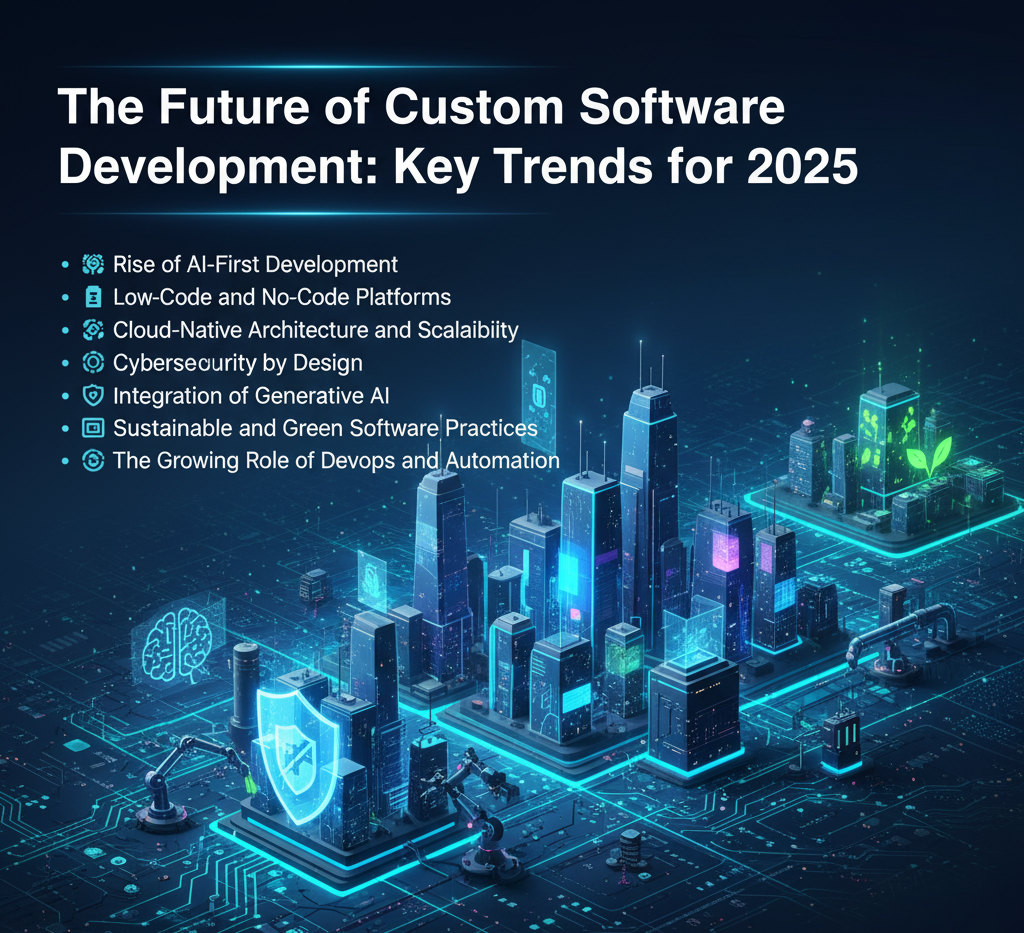
Rise of AI-First Development
Artificial Intelligence is no longer an add-on; it’s becoming the foundation of modern applications. From predictive analytics to intelligent automation, businesses are embedding AI at the core of custom solutions.
Why it matters:
- Enhances decision-making with real-time insights
- Automates repetitive tasks, reducing costs
- Improves personalization and customer engagement
Low-Code and No-Code Platforms
The demand for faster delivery and reduced costs has fueled the adoption of low-code/no-code development. These platforms allow businesses to prototype and deploy applications quickly, often with minimal developer input.
Why it matters:
- Speeds up time-to-market for custom apps
- Empowers non-technical teams to contribute
- Reduces reliance on large development teams
Cloud-Native Architecture and Scalability
With remote work and global customer bases becoming the norm, cloud-native software has moved from optional to essential. Cloud-first design enables applications to scale seamlessly and ensures resilience.
Why it matters:
- Ensures flexibility and global accessibility
- Lowers infrastructure costs
- Simplifies scaling for fluctuating user demands
Cybersecurity by Design
Cyber threats are growing more sophisticated, making security a core pillar of custom software development. The trend is shifting from reactive solutions to “security by design,” where safeguards are built into every layer of the software lifecycle.
Why it matters:
- Protects sensitive customer and business data
- Reduces vulnerabilities from the start
- Ensures compliance with global regulations (GDPR, HIPAA, etc.)
Integration of Generative AI
Generative AI is revolutionizing how custom software interacts with users. From AI-powered chatbots to automated content generation, it creates new opportunities for personalization and innovation.
Why it matters:
- Enables natural, conversational interfaces
- Enhances user experience with predictive features
- Opens new revenue models for businesses
Sustainable and Green Software Practices
Sustainability is becoming a business imperative. Green software development focuses on reducing the carbon footprint of applications by optimizing code, improving energy efficiency, and leveraging eco-friendly infrastructure.
Why it matters:
- Aligns with global sustainability goals
- Attracts eco-conscious customers and investors
- Reduces operational costs through efficiency
The Growing Role of DevOps and Automation
Automation is central to the future of software delivery. DevOps practices are evolving with more advanced CI/CD pipelines, automated testing, and AI-driven deployment strategies.
Why it matters:
- Speeds up development cycles
- Minimizes human error
- Ensures faster delivery without compromising quality
The Future Outlook
By 2025, custom software development will no longer be about simply solving problems—it will be about creating adaptive, intelligent, and sustainable solutions. Businesses that embrace AI-first design, prioritize security, and invest in scalable cloud-native infrastructure will have a decisive edge.
At Technobae, we are committed to helping organizations harness these trends to build solutions that don’t just work today but also thrive tomorrow. From consultation to deployment, our focus is on delivering custom software that maximizes ROI and positions your business for long-term success.
Looking to future-proof your business with custom software solutions?Contact